What Is a Cap Rate?
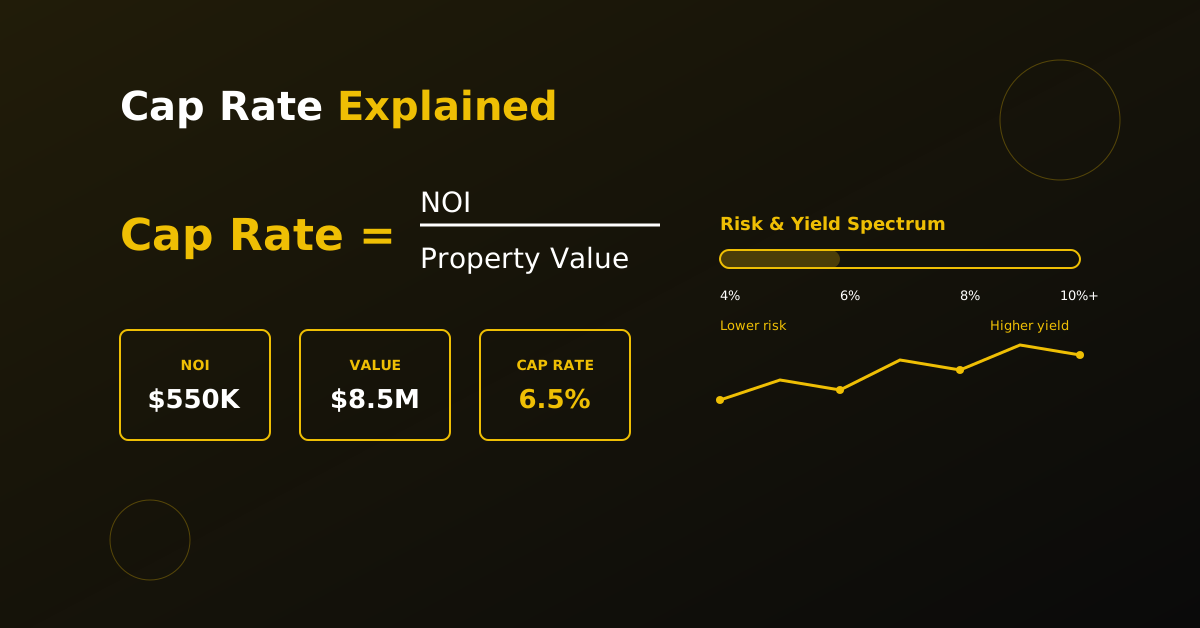
A capitalization rate — or "cap rate" — is the ratio of a property's net operating income (NOI) to its purchase price or current market value. It's expressed as a percentage and represents the unleveraged annual return you would earn if you bought the property with all cash.
Cap rates are the universal language of commercial real estate pricing. When someone says a property is "trading at a 6 cap," they mean the annual NOI equals 6% of the purchase price. It's a quick, standardized way to compare properties regardless of size, location, or property type.
How to Calculate a Cap Rate
Cap Rate Formula
Cap Rate = Net Operating Income / Purchase Price
Example: A property generates $90,000 in annual NOI and is listed at $1,500,000.
$90,000 / $1,500,000 = 6.0% Cap Rate
You can also work the formula in reverse. If you know the NOI and the market cap rate for similar properties, you can estimate value: Property Value = NOI / Cap Rate. This is how appraisers and brokers determine what a property is worth based on its income stream.
What Is a "Good" Cap Rate?
There's no single answer — it depends on the property type, location, tenant quality, lease term, and your investment goals. Generally, cap rates reflect the risk-return tradeoff:
Credit tenants (Walgreens, Chick-fil-A), long lease terms, prime locations. Ideal for capital preservation.
Strong regional tenants, mid-term leases, good secondary markets. The sweet spot for many investors.
Shorter lease terms, local tenants, tertiary markets, or value-add situations. More management and re-tenanting risk.
A lower cap rate means you're paying more per dollar of income — but you're typically getting a safer, more predictable income stream. A higher cap rate offers more yield but comes with more risk. Neither is inherently better; it depends on your investment strategy.
Cap Rate vs. Cash-on-Cash Return
Cap rate and cash-on-cash return are related but measure different things. Understanding both is essential for evaluating deals properly.
Cap Rate
Measures the property's return as if purchased with all cash. Ignores financing entirely. Useful for comparing properties on an apples-to-apples basis regardless of how they're financed.
Cash-on-Cash Return
Measures the annual cash flow relative to the actual cash you invested (your down payment plus closing costs). Accounts for leverage. A 6% cap rate property financed with a loan might yield 8-10% cash-on-cash.
Use cap rate to compare and price properties. Use cash-on-cash return to evaluate how a specific deal performs relative to the capital you're actually deploying. Both metrics matter, and savvy investors look at each when analyzing an opportunity.
Central Florida Cap Rate Ranges
Cap rates in Central Florida vary by property type, tenant strength, and submarket. Here's a general overview of where the market sits for common commercial property types in the Orlando and Space Coast regions:
These are general ranges and will shift based on specific lease terms, location within the metro, and current market conditions. Central Florida has seen moderate cap rate compression over the past several years as demand from out-of-state investors continues to drive pricing.
Frequently Asked Questions
How do you calculate a cap rate on a commercial property?
Cap Rate = Net Operating Income (NOI) / Purchase Price. For example, if a property generates $90,000 in annual NOI and is priced at $1,500,000, the cap rate is 6.0%. You can reverse the formula to estimate value: Property Value = NOI / Cap Rate. NOI is gross rental income minus operating expenses, before debt service.
What is a good cap rate for commercial real estate in Central Florida?
In Central Florida, cap rates typically range from 4.0% to 8.0%+ depending on property type and tenant quality. NNN properties with investment-grade tenants (Walgreens, Chick-fil-A) trade at 4.0–5.5%. Mid-tier NNN and retail strip centers range from 5.5–8.0%. Industrial and flex space falls between 5.5–7.5%. Higher cap rates indicate higher risk or value-add opportunity; lower cap rates reflect stability and credit quality.
What is the difference between cap rate and cash-on-cash return?
Cap rate measures a property's return assuming an all-cash purchase — it ignores financing. Cash-on-cash return measures actual annual cash flow relative to the equity you invested (down payment plus closing costs), so it accounts for leverage. A 6% cap rate property financed with a loan might produce 8–10% cash-on-cash return. Use cap rate to compare and price properties; use cash-on-cash to evaluate how a specific financed deal performs.
Do cap rates go up or down when interest rates rise?
Cap rates generally rise (compress upward) when interest rates increase, because investors demand higher returns to justify the higher cost of debt. When cap rates rise, property values fall for a given level of income. Conversely, when interest rates fall, cap rates tend to compress downward, pushing values higher. The spread between cap rates and the 10-year Treasury yield is a key measure of CRE risk premium.
Need Help Analyzing a Deal?
MaxLife Commercial can help you evaluate cap rates, run the numbers, and determine whether a property fits your investment goals. Central Florida is our market.
Contact UsGet Cap Rate Data and Deals in Your Inbox
Florida cap rate updates and off-market commercial deals, sent to investors who ask for them. No spam, unsubscribe anytime.